On this page
- The short version
- The path to the port of entry
- Your job, your funds and your sponsor before you fly
- Paying the I-901 SEVIS fee
- Documents for the visa interview
- What “port of entry” means
- A last check before you board
- When you may arrive
- Travel to the United States: what to carry on the plane
- How long your visa and passport must stay valid
- If you leave the US during the season
- At the CBP inspection
- After you are through
- Canadian and Bermuda citizens
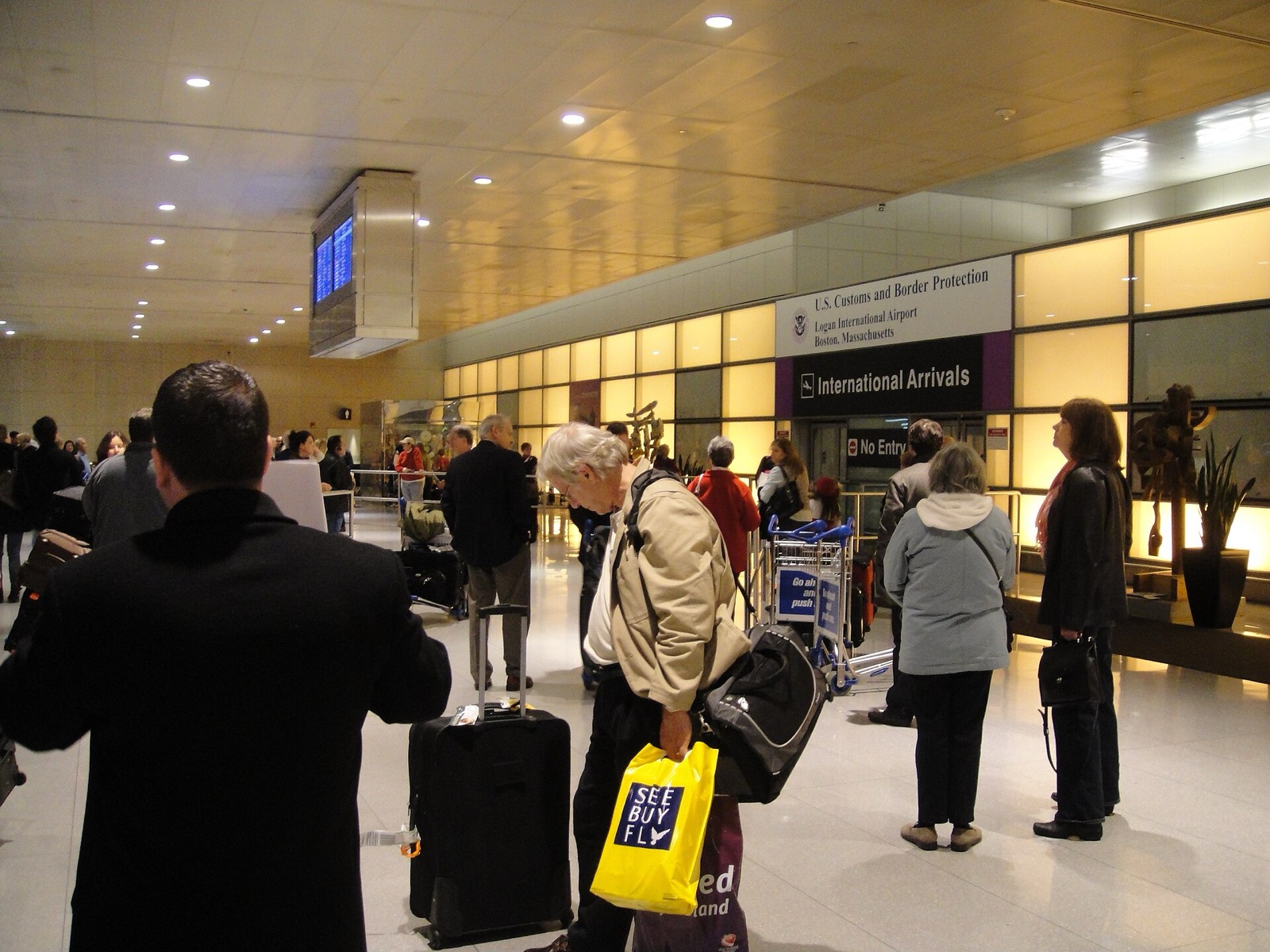
The border is the last test before the season starts. Nothing here is hard if your papers are in order and in your carry-on. This page follows the path from the visa to the officer’s desk, and what you do in the days after. The arrival hub covers the rest of your first days.
The short version
- Bring your passport and DS-2019 to the visa interview.
- Get your J visa before you travel, because exchange visitors must have one.
- Check that your passport is valid for at least six months after your stay.
- Do not arrive more than 30 days before the start date on your DS-2019.
- Remember that a visa does not guarantee entry; officers at the port decide.
The path to the port of entry
Exchange visitor (J) visas are nonimmigrant visas for people approved to take part in exchange visitor programs in the US. Exchange visitors must be issued a J visa to travel to the US. The sequence runs like this:
- Apply to an exchange visitor program through a pre-approved organization in the US.
- Once accepted, you are automatically registered in SEVIS.
- When your registration is active, pay the SEVIS I-901 fee.
- Complete the online visa application and print the confirmation page for your interview.
- After your sponsor enters your information in SEVIS, it sends you the DS-2019.
- Attend the visa interview with a consular officer.
Your job, your funds and your sponsor before you fly
Summer Work Travel is for full-time students at accredited post-secondary institutions outside the US. Participants from outside the visa waiver countries must be pre-placed in a job before entry. Sponsors must provide those participants with pre-arranged, fully vetted employment.
Participants from visa waiver countries may arrive without a job. Their sponsors must make sure they have enough money to support themselves during the job search. Plan the money before you buy the ticket.
Sponsors screen and select participants, and they support and monitor them during the US stay. The rules also require them to give you a 24/7 contact number and the State Department help line number before departure.
Paying the I-901 SEVIS fee
The I-901 SEVIS fee is separate from visa fees. For Summer Work and Travel the fee is $35, per the ICE fee table seen 2026-10-20. Congress mandated it in 2004 for nonimmigrant students and exchange visitors. The SEVIS fee page has the steps.
Pay once your SEVIS registration is active. In some cases the fee is not required, so consult your sponsor. A university guide for its own scholars adds that the fee must be paid at least 3 days before you apply for the visa, and that you present the receipt to the consular officer and again to the immigration officer on entry. Only the J-1 exchange visitor pays, not dependents, per a second university guide. Carry proof of payment, which may be required at points of entry. Staple the receipt to your DS-2019 if you like.
Documents for the visa interview
Interviews are generally required for visa applicants, with limited exceptions. You should schedule yours at the US embassy or consulate. A consular officer interviews you to decide whether you qualify, and you must show that you meet the requirements under US law. Ink-free digital fingerprint scans are taken as part of the process.
Bring this to the interview:
| Item | Detail | Source |
|---|---|---|
| DS-160 | Print the confirmation page | |
| Passport | Valid for at least six months after your period of stay in the US | |
| DS-2019 | Sent by your sponsor after it enters you in SEVIS | |
| SEVIS fee receipt | A university guide for its own scholars advises showing it to the consular officer |
Apply early. Interview wait times vary by location, season and visa category. The wait and processing time varies from country to country and depends on your circumstances.
If the visa is refused
After the interview, the officer may decide that your application needs further administrative processing. If a visa is refused under section 214(b), you may reapply with additional proof of your qualifications, or if your circumstances changed. Misrepresentation of a material fact, or fraud, may result in permanent refusal of a visa or denial of entry. Never bend a fact on a form.
What “port of entry” means
A visa only lets you travel to a US port of entry, generally an airport or land border, and ask permission to enter. The terms customs and port of entry are used interchangeably in the US. At an airport or border crossing you go through customs. So the first US airport you land at is usually your port of entry.
CBP officers at the port have authority to permit or deny admission. A visa does not guarantee entry.
A last check before you board
Confirm that your passport and visa stamp are valid for entry into the US. The State Department rule is passport validity of at least six months after your stay. Carry the original DS-2019 for CBP at the port of entry, whether you arrive by air, land or sea. Keep a printed copy ready, because scans on a phone may not be accepted. Have the SEVIS fee proof in the same folder. Missing papers can cause delays at inspection.
When you may arrive
You may not arrive more than 30 days before the program start date shown on your DS-2019. This applies to exchange visitors beginning new programs. One university guide states it as entering within the 30-day period before the start date indicated on the DS-2019. If you cannot enter before the start date, a university advises asking the sponsor for a new DS-2019 and entering with the new form. If your travel is delayed, a second university can amend program dates when given advance notice. Ask your own sponsor how it handles a late arrival.
After you arrive, you must notify your sponsor within 10 days, as 22 CFR 62.32 requires sponsors to tell you. Report each change of residence within 10 days as well.
Travel to the United States: what to carry on the plane
Put your papers in your carry-on bag, because you cannot reach checked luggage until later. Be ready to present them to an immigration officer at the airport.
- Passport, valid for at least six months after your period of stay.
- Your visa.
- A printed DS-2019, since scans on an electronic device may not be accepted by US authorities.
- Proof of SEVIS fee payment.
- A photocopy or digital backup of the DS-2019 and other essential papers, kept while you travel.
- A job offer or job-search funds, if your sponsor placed or did not place you.
How long your visa and passport must stay valid
Your passport must be valid for at least six months after your period of stay in the US. A university guide for its own scholars adds that the visa does not need to remain valid after you have used it to enter. Your DS-2019 and passport must remain valid at all times, the same guide advises. Check these three dates before you buy a ticket.
A visa works for one program and one sponsor. If you later join a second exchange program with a different category and sponsor, you need a new Exchange Visitor visa. Sponsors are responsible for screening and selecting eligible participants, and for supporting and monitoring them during their US stay.
If you leave the US during the season
Coming back in means another CBP inspection. CBP reviews your documents on re-entry, and missing papers can delay you. The inspection checks that your J-1 visa and supporting documents are valid.
Before you go, ask your sponsor to sign your DS-2019 for travel validation. CBP decides on admission again at each port of entry. Your J-1 visa must still be valid on the day you return. Carry a printout of your I-94 record. Keep a backup of your DS-2019 and other essential papers.
At the CBP inspection
At a US port of entry you go through CBP inspection. After you present your passport, visa and DS-2019, a CBP officer decides whether to admit you. Inspection checks that your visa and supporting documents are valid. Missing documents can cause delays.
Once you are allowed in, the CBP officer provides an admission stamp or a paper Form I-94. Per a university guide, the officer stamps the DS-2019 and passport and generates the I-94.
A paper form can be requested during inspection, handled in a secondary setting. There are over 70 deferred inspection sites where documents can be reviewed or corrected.
After you are through
The I-94 page covers the record in detail. The admission stamp or paper I-94 comes from the CBP officer at inspection, and a university guide says your proof of J-1 status is on the I-94. Carry a printout of your I-94 record with your other papers.
Then contact your sponsor. The program rule gives you 10 days after arrival to notify them. One university guide, written for its own scholars, says status changes to NO SHOW if you do not report within 30 days of the program start date, and that reporting validates the SEVIS record and gives ACTIVE status. Your sponsor’s steps are on the SEVIS validation page. For the next step, see the Social Security number page.
On July 17, 2026, DHS published a final rule on a fixed period of admission and an extension of stay procedure for J exchange visitors. As of 2026-10-20 (USCIS I-539 page), a federal court order of Sept. 14, 2026 postponed that rule’s effective date and USCIS proceeds under the previous regulatory provisions. Check the dates on your own admission record.
Canadian and Bermuda citizens
Citizens of Canada and Bermuda may enter the US as exchange visitors without a visa. They must present a valid DS-2019 at the border or airport. Canadian citizens are visa-exempt and need no J-1 visa stamp. The DS-2019 is the paper that matters at the border. Like every arrival, you go through CBP inspection at the port of entry, and missing documents can cause delays there.
Questions new arrivals ask
What does port of entry mean on a visa application?
A port of entry is generally an airport or land border where a visa holder asks permission to enter the US. A visa only allows travel there and a request to enter. A university guide adds that customs and port of entry are used interchangeably in the US.
What should I bring to my J-1 visa interview?
Print the DS-160 application confirmation page and bring it to the interview. Your passport must be valid for at least six months after your period of stay in the US. A university advises showing the SEVIS fee receipt to the consular officer.
What is the new rule for J-1 visa holders?
On July 17, 2026, DHS published a final rule establishing a fixed time period of admission and an extension of stay procedure for J exchange visitors, among others. As of 2026-10-20 (USCIS I-539 page), a federal court postponed the rule's effective date on Sept. 14, 2026. Check the dates on your own admission record.
How long does J-1 visa processing take?
It varies. Wait time for an interview and processing varies from country to country and depends on your individual circumstances. Interview wait times also vary by location, season and visa category, so apply early.
Does a J-1 visa guarantee entry into the US?
No. A visa does not guarantee entry into the US. CBP officers at the port of entry have authority to permit or deny admission. Misrepresentation or fraud to obtain a visa may lead to permanent refusal or denial of entry.
How early can I arrive before my program starts?
You may not arrive more than 30 days before the program start date shown on your DS-2019. If you cannot enter in that window, a university guide advises asking the sponsor for a new DS-2019 and entering with the new form.
Read next
Arrival
I-94 for J-1 Summer Work and Travel: How to Get, Print and Read Your Record
How a J-1 Summer Work and Travel participant gets, prints and reads the I-94 record: online access, Admit Until Date, I-94 number, errors, fee and leaving.
Arrival
SEVIS Validation for J-1 Summer Work and Travel: What It Is and When to Do It
What SEVIS validation means for a J-1 Summer Work and Travel participant, the 10-day sponsor rule, sponsor deadlines, how to check status and what it unlocks.
Arrival
Social Security Number for J-1 Summer Work and Travel: Steps, Documents and Timing
How a J-1 Summer Work and Travel participant applies for a Social Security number: SEVIS first, online start, in-person visit, documents, 45 days, card timing.
Sources
- Exchange Visitor Visa (U.S. Department of State, travel.state.gov; via Wayback capture 2025, seen 2026-10-20) · U.S. Department of State · travel.state.gov · checked October 20, 2026
- Common Questions, BridgeUSA J-1 Visa Basics (U.S. Department of State) · U.S. Department of State, Bureau of Educational and Cultural Affairs · j1visa.state.gov · checked October 20, 2026
- Arrival/Departure Forms: I-94 (U.S. Customs and Border Protection) · U.S. Customs and Border Protection · cbp.gov · checked October 20, 2026
- I-901 SEVIS Fee (ICE; page carries the DHS final rule notice, seen 2026-10-20) · U.S. Immigration and Customs Enforcement · ice.gov · checked October 20, 2026
- Summer Work Travel (J-1 BridgeUSA, U.S. Department of State) · U.S. Department of State, Bureau of Educational and Cultural Affairs · j1visa.state.gov · checked October 20, 2026
- 22 CFR 62.32 Summer work travel (eCFR) · eCFR (U.S. Government Publishing Office) · ecfr.gov · checked October 20, 2026
- 22 CFR 62.10 Program administration (eCFR) · eCFR (U.S. Government Publishing Office) · ecfr.gov · checked October 20, 2026
- J-1: Coming to the U.S. (University of Washington, for its own scholars) · University of Washington · ap.washington.edu · checked October 20, 2026
- Exchange Visitor Pre-Arrival Guide for Canadian Citizens (University of Utah, for its own scholars) · University of Utah · isss.utah.edu · checked October 20, 2026
- J-1 Visa Travel Restrictions: Key Tips (Cultural Vistas, a J-1 sponsor's own page) · Cultural Vistas (designated J-1 sponsor) · culturalvistas.org · checked October 20, 2026
- Arriving in the U.S. (Indiana University Bloomington, for its own students) · Indiana University Bloomington · bloomington.iu.edu · checked October 20, 2026
- I-539, Application to Extend/Change Nonimmigrant Status (USCIS; alert on the final rule, seen 2026-10-20) · U.S. Citizenship and Immigration Services · uscis.gov · checked October 20, 2026
- I-901 SEVIS Fee FAQ (ICE, fee table) · U.S. Immigration and Customs Enforcement · ice.gov · checked October 20, 2026
Image credits (1)
- hildgrim / Wikimedia Commons · CC BY-SA 2.0 · source

Fees, forms and wage rates change: each source shows the date it was checked. How we check facts · Report an error.